
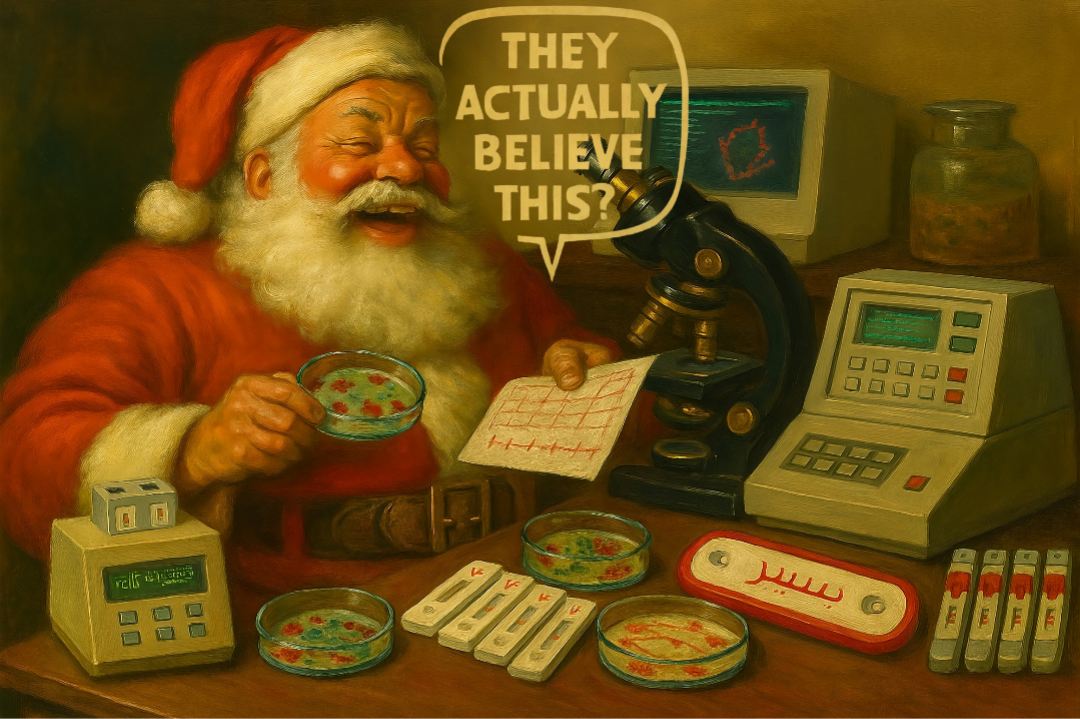
ViroLIEgy 101: The Santa Analogy
The power of belief disguised as scientific evidence.
ViroLIEgy 101 is a series of articles meant to provide relatively short (by my standards) and concise explanations of key concepts regarding both germ “theory” and virology. I’m providing an overview on topics that are essential to the conversation that people may be confused with and have difficulty understanding, or areas that seem to be controversial when engaging in discussions with those defending the germ “theory” of disease.
Every Christmas morning, presents appear under the tree. The children take this as proof that Santa made his yearly visit. After all, the wrapping paper, shiny tags, and cheerful notes all seem unmistakable. They never stop to question whether someone else could have been responsible, because the story they’ve been told explains everything perfectly. What more evidence could anyone possibly need?
This, in essence, is how virology persuades the world to believe in an invisible agent using only indirect evidence. It’s the psychology at the core of the Santa analogy, and it’s why I keep returning to it when I talk about virology. The analogy offers a clear visual for how virologists construct belief: replace presents, crumbs, and handwritten notes with particles, “antibodies,” and genome fragments, and the pattern doesn’t change. A messy, ambiguous scene is turned into a tidy narrative simply because the narrative already exists and people expect to see it. All it takes is an unquestioning mind, a compelling emotional hook, and a willingness—sometimes even a need—to believe.
Just as children interpret holiday clues as proof of Santa’s visit, virologists interpret laboratory observations as proof of a “virus.” The pattern of reasoning is the same—belief built on indirect evidence. In this analogy, the presents represent the particles seen in experiments, the special wrapping paper corresponds to the biochemical pattern assumed to be unique to a “virus,” and the tags—or “antibodies”—are the labels scientists claim can identify those patterns with magical precision, distinguishing “viral” presents from ordinary ones.
A few cookie crumbs are found on the table, and tests confirm they contain fragments of Santa’s DNA. With that, the scientists declare victory: Santa exists! Of course, no one has ever seen Santa himself, just the indirect traces interpreted as his handiwork.
To strengthen the case, some researchers produce letters from Santa—handwritten notes that conveniently confirm what everyone already believes. Only later do we learn that these letters were actually composed by the same people claiming to be objective investigators. They call this “molecular sequencing.”
And for those who still doubt, there are now AI-generated images of Santa, complete with his sleigh, beard, and sack of gifts. They look incredibly real, just like those colorized electron micrographs of “viruses” that are, in truth, composites and reconstructions. The public is shown pictures of what Santa “would look like” if he existed, and most people stop asking questions.
But here’s the most important part of the story: all of this “evidence” begins with the Christmas tree itself. The tree is covered in ornaments of every color and shape: glass bulbs, tinsel, candy canes, lights, and random glitter from last year. This represents the cell culture, a complex mixture of countless biological components—cells, fluids, nutrients, antibiotics, and more. From this chaotic scene, the investigators focus on a few sparkly ornaments they like and declare, “Aha! These must be Santa’s!”
They never actually isolate or purify the supposed “Santa decorations” from the rest of the tree. Instead, they interpret changes in the tree’s appearance—some needles fall off, the lights flicker—as proof that Santa visited and tinkered with it. In virology terms, that is called the “cytopathic effect.”
So, from one messy, mixed-up tree, they infer an entire mythology: the presence of Santa, the pattern of his wrapping paper, the identity of his tags, the sequence of his crumbs, and even his portrait. Each layer of interpretation builds upon the last, never requiring Santa himself to appear—only the continued belief that he must have been there.
In the end, the family doesn’t need to see Santa in action inside their house to believe in him. They have the presents, the crumbs, the letters, and the photos, all traceable back to the same messy tree.
Likewise, in virology, every strand of supposed “evidence” for the existence of “viruses” ultimately traces back to one unpurified culture. The presents, the crumbs, and the letters are all real observations, but they’re not proof of Santa. They’re the effects of belief, not the cause of it. Likewise, in virology, every piece of “evidence” grows from the same culture, a decorated tree of assumptions dressed up in glittering tags and ornaments. The evidence isn’t independent; it’s inherited from the story itself.

Back in September 2023, I wrote The Indirect Effect—my first attempt to explain the Santa analogy and virology’s reliance on indirect rather than direct evidence, substituting inference and assumption for empirical demonstration. Indirect evidence is a combination of facts that, if true, allows a person to infer another fact—but it does not directly prove it. Direct evidence, by contrast, demonstrates a fact outright. This kind of evidence is entirely missing in virology, as even acknowledged in the 2020 review History of Early Bacteriophage Research and Emergence of Key Concepts in Virology:
“While the quality standards of modern science impose obtaining direct evidence and visualization of the phenomena and objects studied, the methodology of science of the earlier period largely relied on making conclusions based on multistep indirect deductive reasonings, which would not be accepted as sufficiently convincing by the peer reviewers of the modern scientific journals. Nevertheless, these were the approaches that required extensive laboratory work and enormous intellectual efforts in planning the experiments and analyzing the obtained data, and as a result of these approaches, main postulates of molecular biology and the highly important biology concepts were developed including the concept of a virus as a transmissive genetic program.”
This passage inadvertently admits that the concept of a “virus” was not established through direct empirical observation but through layers of indirect reasoning that would not meet modern scientific standards. In essence, early virologists inferred the existence of an unseen agent from assumed effects—much like concluding Santa must exist because presents appear under the tree. Both rely on interpreting circumstantial evidence through a preexisting belief rather than demonstrating the cause itself. While the author frames this as a testament to scientific ingenuity, it’s actually a quiet confession that the “virus as a transmissive genetic program” was a theoretical construct—an idea built on inference, not a directly observed or independently verified entity.
If you’ve ever watched a child’s unwavering belief in Santa Claus, you’ve seen how easily conviction can spring from a series of comforting assumptions. The gifts appear, the cookies go missing, and the sound of sleigh bells seals the story. Evidence? None that can withstand scrutiny—but the pattern feels so complete that doubt never enters the mind. Virology was built on the same kind of logic: indirect signs interpreted as proof of an unseen cause. From the earliest “filterable agents” to modern genome assemblies, belief in the “virus” has been sustained not by direct observation, but by circular reasoning that has been passed off as discovery.
If one takes a brief look at the indirect methods utilized by virologists to conjure up belief in invisible “viruses,” the analogy with Santa becomes even more clear.
Filterability: The Birth of an Invisible Agent

Just as children take the appearance of presents under the tree as “proof” that Santa exists without ever seeing him, early bacteriologists took disease symptoms from filtered fluids as proof of an invisible “pathogen” without ever isolating or directly observing it. When their filters supposedly removed all known bacteria yet the fluids still caused disease, they assumed something smaller—something unseen—must be responsible.
As Field’s Virology and A History of Experimental Virology recount, these early “viruses” were defined not by direct observation of the entities themselves, but indirectly by the observed effects. It was assumed that filterable agents were present and passed through filters said to block bacteria, and that they produced certain symptoms in test animals. That was enough for researchers to declare the discovery of new “filterable viruses.” Yet the filters themselves were inconsistent, prone to adsorption and contamination, making the results unreliable. Despite this, virologists confidently assigned estimated sizes to invisible agents they could neither see nor purify.
Even Introduction to Modern Virology admits that the first definition of a “virus” was entirely negative—it could not be seen or cultivated. The entire “virus” concept arose not from the detection of a tangible entity, but from the absence of bacteria and the persistence of symptoms. Like believing in Santa because the gifts keep showing up, virologists believed in “filterable viruses” because their assumptions demanded that something unseen must be there.
Animal Experiments: Begging the Question in the Lab

Just as children mistake the sound of footsteps on the roof as proof that Santa is real, early researchers mistook artificial lab reactions for proof that an invisible “pathogen” existed. Robert Koch once stated that the only direct proof of a germ causing disease was to recreate the same illness in a healthy host using a pure culture of the organism. But when this proved impossible—especially for diseases like cholera or yellow fever—scientists quietly abandoned Koch’s own logical scientific standard. As Lester King pointed out, they began to “beg the question” on a colossal scale: assuming that an injected fluid contained the disease-causing agent, then claiming success when symptoms—often unnatural ones—appeared in animals.
From scarifying animal mouths and rubbing in diseased material (for foot-and-mouth disease), to injecting crushed spinal cords into monkey brains (for polio), the methods were anything but natural. Yet the resulting symptoms were taken as “proof” of a “virus,” even though the filtrates used were unpurified mixtures of unknown substances. Like children interpreting every bump in the night as Santa’s sleigh, virologists interpreted every unnaturally-derived experimental reaction as confirmation of their preexisting belief. What they called “direct evidence” was, in truth, a chain of assumptions held together by circular reasoning.
Antibodies: Circular Logic in Disguise

Just as children infer Santa’s existence from the appearance of gifts with special wrapping paper appearing under the tree, immunologists inferred “antibodies” from indirect reactions seen in lab tests. When Emil von Behring observed that animals injected with diphtheria toxin sometimes survived later exposures, he concluded that the blood must contain protective “antitoxins.” Yet, these supposed substances were never purified or directly observed—only inferred from effects. From this assumption came the idea of “antibodies,” invisible defenders said to bind equally to invisible “antigens.” The logic quickly became circular: “antibodies” were used to prove “viruses” existed, and “viruses” were used to prove “antibodies” existed—each imaginary entity reinforcing belief in the other.
Critics at the time, including Felix Le Dantec and Henry Dean, pointed out that these “antibodies” had never been isolated, that their supposed chemical nature was unknown, and that belief in them merely replaced understanding with terminology. Yet, from these assumptions arose tests like complement fixation, which mixed animal blood, sera, and patient samples to detect indirect reactions—results known to be non-specific and unreliable. Much like believing in Santa to explain why the presents appear, scientists believed in “antibodies” to explain why test reactions occurred, mistaking assumption for evidence and circular reasoning for discovery.
Cell Culture: The Decorated Tree

Just as children believe Santa must exist because presents appear under the decorated tree, virologists believe “viruses” must exist because cells in a lab dish break down after being poisoned, starved, and exposed to unpurified mixtures. The Christmas tree represents the foundation of the belief itself—an elaborate setup filled with ornaments and glitter that give the illusion of Santa’s visit, just as the complex cell culture gives the illusion of “viral” activity. The opening of Introduction to Modern Virology admits that “viruses are usually detected indirectly,” primarily through cell culture, serology, or nucleic acid tests—not through direct observation. Because “viruses” were said to be too small to see, early virologists claimed that their presence could only be inferred when cells died or changed appearance—a phenomenon called the cytopathic effect (CPE).
When John Enders introduced the cell culture method in 1954, he mixed human and monkey kidney cells with patient throat washings, animal sera, antibiotics, and other additives. When the cells eventually deteriorated, he assumed the unseen “measles virus” was multiplying inside them. But his own paper admitted that the same effects occurred in cultures with no so-called “viral” sample added. Later studies confirmed that CPE could arise from countless “non-viral” causes—antibiotics, toxins, contamination, or simply dying cells. Despite this, virologists still interpret cell death as proof of “viral replication.”
This reasoning is circular: cell damage is taken as evidence of a “virus,” yet the “virus” itself is defined only by the cell damage it supposedly causes. The assumed cause is both inferred from and used to explain the same effect—a perfect illogical loop. Like insisting Santa must exist because the gifts are there under the decorative tree, virologists claim “viruses” exist because the cells die, and the cells die because “viruses” exist.
Electron Microscopy: Pictures of Belief

Just as children mistake a blurry photo of a red suit for proof that Santa exists, scientists mistake filtered debris and digital reconstructions for direct evidence of a “virus.” The electron microscope, developed in 1931, finally allowed scientists to see particles small enough to fit the size of the presumed “filterable viruses.” Yet it wasn’t until after Enders’ 1954 cell culture method that electron microscopy regularly began to be used to “visualize” them—always within the unpurified, chemically altered soup of the culture supernatant.
To prepare samples, tissues are killed, dehydrated, embedded, stained with heavy metals, and bombarded with electrons before the resulting images are digitally interpreted. As neurobiologist Harold Hillman pointed out, what ends up as a neat illustration in a textbook is many steps removed from any living process. Much of what appears under EM, he argued, are artifacts created by the preparation itself—not real biological structures.
Virologists then sift through this chaos of cellular debris, searching for a particle that looks like what they expect to see. Whether it’s Almeida identifying “coronaviruses” in 1967 or Montagnier searching for “HIV,” the “virus” is always chosen from among countless similar shapes based on interpretation—not isolation. Even normal cellular components like vesicles and Golgi bodies have been mistaken for “viruses.” Studies have even shown “SARS-COV-2” particles appearing in both positive and negative samples, and in tissues collected before 2019.
Like spotting Santa’s shadow in every flicker of light, EM interpretation depends entirely on belief. The images are not of purified, isolated particles, but of unverified mixtures. The observer assumes the existence of a “virus” and then declares, “There it is,” using the image as evidence of the very thing already presumed. It’s circular reasoning turned into an illustration—a picture of a belief, not proof of reality.
Genomes: Assembling Santa’s DNA

Just as children piece together a trail of cookie crumbs and half-drunk milk to “prove” Santa was there, scientists piece together random genetic fragments and call the result a “viral genome.” Imagine someone handing you a printout of a DNA sequence and insisting it proves Santa exists. When you ask how they got it, they explain that it was assembled from bits of wrapping paper, cookie crumbs, and stray beard hairs found by the fireplace. You point out that none of that can actually be verified to have come from a magical being, but they assure you that since the sequence doesn’t match anything else in the database, it must be his.
That’s essentially how “viral” genomes are made. Scientists take unpurified genetic material from mixed samples—full of human, bacterial, and other RNA—and then assemble a theoretical genome by comparing it to databases filled with other unverified “viral” sequences. The result? A circular argument where imaginary entities are used to validate one another. Just as a printout of Santa’s supposed DNA would be meaningless without Santa himself, a string of A, C, T, and G’s means nothing without a purified and isolated “virus” to sequence from. Yet modern virology continues to treat these digital ghosts as proof of “viral” reality.

The Santa story didn’t survive because children gathered evidence. It survived because adults, institutions, books, movies, and traditions kept feeding it to them. Virology operates the same way: the narrative persists not because it’s been proven, but because it’s endlessly repeated by authority figures, reinforced through textbooks, media, grants, and career incentives. Stories become “truth” when institutions repeat them long enough.
Like children who insist that Santa is real because the presents appear under the tree, virologists cling to their belief in invisible boogeymen because their experiments produce effects they’ve already decided must be “viral.” They’ve been conditioned to confuse indirect signs with direct proof and to mistake institutional repetition for reality.
The entire system functions as a self-reinforcing faith. Professors teach students that “viruses” are proven, those students become researchers who never question the premise, and the cycle renews itself with every new grant and publication. Doubt is treated as heresy, not inquiry. When asked to produce the purified, isolated “virus” itself—something visible, tangible, and verifiable—they instead offer models, sequences, and simulations. The map becomes the territory, and the illusion sustains itself through authority, not evidence.
Like children defending Santa from older kids on the playground, virologists lash out at anyone who dares question the story. But it isn’t toys or cookies at stake, it’s careers, reputations, and entire institutions built upon the belief. Their comfort depends on the illusion’s survival, and so they guard it fiercely.
Virology thrives on this cultivated innocence. The comfort of consensus replaces the discomfort of logic. Cognitive dissonance seals the illusion in place, making disbelief seem like ignorance and skepticism like blasphemy.
The difference is that children eventually grow up. When they learn that Santa was a story, they laugh, adjust, and move on. The tragedy is that children outgrow their myths, but virology institutionalized its own. Virologists remain trapped in the fantasy, doubling down no matter how clearly the evidence contradicts it.
And that’s where the Santa analogy ends—because children eventually face reality. Virologists don’t.
Skeptical Santa Sweatshirts


To commemorate this very effective analogy, I’ve designed festive Christmas sweaters for anyone who wants to spread the message with family, friends, and holiday shoppers this season. They’re available at the ViroLIEgy shop—use promo code VLFREE75 for free shipping on orders of $75 or more.
This holiday season, let’s be like Santa checking the list twice—carefully examining the claims of virology, exposing fallacious reasoning and reliance on indirect evidence. Just as Santa separates naughty from nice, we can help others see the difference between assumptions and proven science. Spread awareness, share the truth, and make this season one of critical thinking and clarity.
3 Responses
Gf7777
Great article Mike. I hope your analogy makes it easier for people to understand the fundamental problem with virology. It abandoned Koch’s postulates a long time ago. The postulates were a proxy for the scientific method. We know virology cannot produce an independent variable and, therefore, functions within scientific instrumentalism, which does not need an independent variable. That is the fundamental difference between scientific realism and instrumentalism. These analogies are great. Here’s one for you just for fun:
Arbovirology: Modeling Leaf Drop as Seasonal Infection
I. Observed Phenomenon
Each autumn, vast populations of deciduous trees undergo a striking transformation: their leaves change color, wither, and fall en masse. This process is highly patterned, geographically synchronized, and follows a predictable temporal curve. From an epidemiological standpoint, it resembles a seasonal outbreak—a wave of decline sweeping through a population with remarkable regularity.
II. The Arboviral Model
To explain this phenomenon, a theoretical construct is introduced: the Arbovirus. This hypothetical pathogen is said to infect deciduous trees, triggering a cascade of symptoms:
– Chlorophyll degradation (leaf yellowing)
– Anthocyanin overproduction (red and purple pigmentation)
– Cellular apoptosis in leaf tissue
– Mass abscission events (leaf drop)
The model posits that the virus is transmitted via wind, insects, or fungal vectors, and that its spread is modulated by environmental conditions such as temperature and daylight duration.
III. Detection and Confirmation
Arbovirologists employ a range of techniques to support the model:
– PCR-like assays detect genetic fragments in leaf tissue, interpreted as viral signatures.
– Microscopy reveals cellular changes consistent with viral cytopathic effects.
– Epidemiological mapping tracks the spread of “infection” across regions, showing consistent southward progression in the Northern Hemisphere.
– Mathematical modeling predicts the timing and severity of outbreaks based on climate data and prior-year patterns.
These methods yield model-consistent effects, reinforcing the Arboviral hypothesis. Yet none of them isolate a virus as an independent causal agent. The model remains instrumentally successful, but ontologically unverified.
IV. Competing Models and Interpretive Closure
Alternative explanations—such as photoperiodic signaling, hormonal regulation, or abiotic stress responses—are acknowledged but often reframed within the Arboviral model. For instance:
– Hormonal shifts are interpreted as host responses to viral infection.
– Environmental triggers are seen as modulators of viral activity.
– The absence of a purified virus is attributed to its cryptic nature or integration into host genomes.
Thus, the model maintains its central causal claim by reinterpreting all evidence through its own lens, rather than testing the necessity of the virus construct itself.
V. Philosophical Implication
This analogy illustrates how a model can achieve predictive power and empirical coherence without demonstrating the independent existence of its central entity. The Arboviral model organizes observations, guides research, and forecasts outcomes—but it does so without requiring proof that the virus exists as a discrete, manipulable cause.
Like Santa Clausology and Unicornology, Arbovirology reveals the instrumentalist structure of much scientific practice: what matters is not what is, but what works. The risk arises when instrumental success is mistaken for ontological confirmation, and when alternative models are excluded not by evidence, but by the interpretive inertia of dominant frameworks.
Brandon
Excellent analogy and funny too.
Mike Stone
Thank you, Christian. 🙂